Custom Metal, PVC, Plastic, and Rubber Promotional Car Key Chains: A Practical B2B Guide for Brand Visibility and Everyday Use
Custom car key chains remain one of the most widely used promotional accessories in the automotive, retail, logistics, hospitality, and corporate gifting sectors. For international B2B buyers, the value of a key chain is not limited to appearance. A well-designed product must balance material durability, brand presentation, comfort in daily use, and efficient mass production. When produced in metal, PVC, plastic, or rubber, a promotional car key chain becomes more than a giveaway item: it becomes a functional brand touchpoint that is handled repeatedly, carried everywhere, and seen in high-frequency environments.
This article focuses on the technical and application advantages of custom metal, PVC, plastic, and rubber car key chains, with an emphasis on material selection, manufacturing methods, durability, and use cases. For buyers sourcing promotional gifts for dealerships, trade shows, service centers, fleet programs, or retail campaigns, understanding these product differences helps improve purchasing decisions and reduce quality risks.
Why Custom Car Key Chains Remain a Strong Promotional Product
Car key chains perform a simple task, but that simplicity is exactly why they are effective. They are compact, lightweight, easy to distribute, and used frequently. Compared with many promotional items that are stored away, a key chain stays visible during commuting, parking, key handling, and daily travel. This repeated exposure supports long-term brand recognition without requiring electronic components or complex maintenance.
From a procurement perspective, key chains also offer strong flexibility in design. Buyers can request 2D or 3D logos, molded shapes, engraved text, printed graphics, or multi-material combinations. This makes them suitable for automotive brands, parts suppliers, service companies, insurance agents, mobility platforms, and exhibition campaigns. For international buyers, the product’s export-friendly size also helps reduce logistics complexity and warehouse space requirements.
Material Options: Metal, PVC, Plastic, and Rubber
Metal Key Chains for Premium Brand Positioning
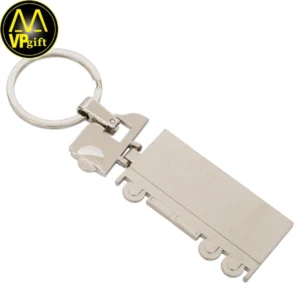
Metal key chains are often selected when the intended message is quality, reliability, or technical precision. Common materials include zinc alloy, stainless steel, iron, and aluminum. Zinc alloy is particularly popular for custom shapes because it supports die-casting, allowing detailed contours, recessed logos, and layered 3D structures. Stainless steel offers excellent corrosion resistance and a clean, modern appearance, while aluminum is valued for its lighter weight.
Surface finishing is a major advantage in metal production. Options may include polishing, brushing, electroplating, sandblasting, enamel filling, or antique-style finishing. These treatments help improve tactile feel and visual differentiation. For B2B buyers, metal key chains are especially suitable for dealer gifts, executive giveaways, vehicle launch events, and premium loyalty programs.
PVC and Rubber Key Chains for Flexible Design and Color Expression
PVC and rubber key chains are frequently chosen for their soft touch, vivid colors, and highly customizable molded shapes. These products are typically made through soft PVC molding or rubber-style molding processes that allow layered color separation and complex logo reproduction. The material is flexible, impact-resistant, and easy to wear in everyday use.
These key chains are ideal for brands that want a playful, approachable, or youth-oriented identity. They are also effective for event campaigns, car clubs, children’s safety programs, maintenance promotions, and seasonal marketing activities. Because the material is soft and lightweight, it is comfortable to carry and less likely to scratch other objects in a pocket or bag.
Plastic Key Chains for Cost-Efficient Mass Distribution
Plastic key chains are often used for large-volume promotional campaigns where the key requirement is cost control without sacrificing basic functionality. Common plastics include ABS, acrylic, and other injection-molded materials. Injection molding supports consistent dimensions, smooth surfaces, and efficient production at scale. Clear or translucent plastic can also create modern visual effects when combined with printed inserts or embedded graphics.
Plastic is suitable for product launches, roadshow events, service reminders, and broad distribution campaigns. It offers a practical balance between weight, durability, and production speed. For buyers working with tight deadlines or wide distribution networks, plastic key chains can be an efficient option.
Technical Features That Matter to B2B Buyers
When sourcing custom promotional car key chains, appearance is only one part of the evaluation. Technical details influence performance, return rates, and brand perception. A reliable product should include a secure key ring or split ring, stable attachment hardware, and a surface finish that resists fading or peeling under normal use.
For metal key chains, buyers should consider plating thickness, die-cast precision, and edge smoothness. Sharp edges or poor polishing can affect user comfort and lead to inconsistent quality. For PVC and rubber products, mold quality is critical because it determines logo clarity, line accuracy, and color separation. In plastic items, dimensional stability and print adhesion are important, especially when the design includes full-color graphics or transparent components.
Weight is another practical factor. A key chain that is too heavy may feel uncomfortable on a car key or ignition key set, while a product that is too light may feel low-value. The ideal weight depends on the application: premium gifts often use solid metal construction, while mass promotional campaigns may favor lightweight PVC or plastic.
Manufacturing Processes and Quality Control
The production method should match both design complexity and intended use. Metal key chains usually begin with mold development and die-casting or stamping, followed by polishing, surface treatment, coloring, and assembly. PVC and rubber products generally require mold making, material mixing, injection or filling, curing, trimming, and final assembly. Plastic key chains are commonly produced through injection molding, followed by printing, assembly, or decorative finishing.
Quality control should include checks for color consistency, logo placement, seam alignment, hardware strength, and surface defects. For export buyers, packaging quality is also important. Individual polybags, paper inserts, custom backing cards, or retail-ready boxes can support distribution efficiency and improve the unboxing experience. Buyers working with multiple markets should also confirm compliance requirements related to material safety, packaging labeling, and shipping protection.
Best Application Scenarios for Promotional Car Key Chains
One of the most valuable advantages of a custom car key chain is its versatility across different business environments. Automotive dealerships often use them as delivery gifts, service reminders, or test-drive souvenirs. Repair shops and maintenance centers can use them to reinforce appointment schedules or loyalty programs. Fleet operators may apply them as vehicle identification accessories or staff-issued items. Retail brands and mobility companies can distribute them during seasonal promotions and trade fairs.
For corporate buyers, car key chains are also effective in internal programs. They can support employee welcome kits, safety initiatives, vehicle handover packages, and customer retention campaigns. Because they are compact and easy to brand, they can be adapted to both local and international campaigns without significant modification to fulfillment systems.
Design Strategy: Matching Material to Brand Message
Choosing the right material is not just a manufacturing decision; it is a branding decision. A metal key chain suggests precision, durability, and a professional image. PVC and rubber communicate flexibility, color, and creative shape design. Plastic offers efficiency and scalability for broad outreach. Buyers who match the material to the campaign objective usually achieve stronger user acceptance and better perceived value.
For example, a premium auto dealership may prefer embossed metal with polished edges and plated finishing, while a new vehicle model promotion may benefit from a colorful rubber design shaped like the vehicle silhouette. A service network running a mass distribution campaign may choose injection-molded plastic for efficient delivery across many locations. This material-to-message alignment improves the effectiveness of the promotional product and reduces mismatch between appearance and brand positioning.
Sustainability and Efficiency Considerations
Many B2B buyers now consider sustainability during procurement. While the product is small, material selection and production efficiency still matter. Metal key chains can offer long service life, which may reduce replacement frequency. Plastic and PVC products can be optimized through compact molding, reduced waste design, and efficient logistics. Where appropriate, buyers may also request packaging simplification, material reduction, or recyclable secondary packaging to improve environmental performance.
Production efficiency is another factor linked to sustainability. Accurate mold design reduces scrap, while consistent quality lowers the risk of rework and returns. For international buyers, this means fewer shipping disruptions and better supply chain predictability. In high-volume campaigns, a well-controlled production process can significantly improve both operational efficiency and product consistency.
How to Evaluate a Supplier for Custom Key Chain Orders
When selecting a supplier, buyers should review mold capability, material options, finishing methods, sample turnaround, and mass production consistency. It is also helpful to assess whether the supplier can support design refinement, because small changes in thickness, edge radius, or attachment choice can improve usability and lower production risk. A supplier with experience in both promotional and retail-quality products is usually better equipped to handle varied international requirements.
Clear communication is essential. Buyers should provide artwork in the correct format, define target dimensions, specify color references, and confirm packaging needs early in the process. Sample approval should include checks for tone, form accuracy, logo detail, and hardware reliability. This reduces the chance of deviations during full production.
Conclusion: A Small Product with High Brand Exposure
Custom metal, PVC, plastic, and rubber promotional car key chains offer a practical combination of utility, branding space, and manufacturing flexibility. Their small size makes them economical to ship and easy to distribute, while their daily use ensures repeated brand exposure. For international B2B buyers, the real value lies in selecting the correct material, production method, and finish for the intended market and application.
Whether the goal is premium positioning, colorful promotional impact, or efficient mass distribution, a well-designed car key chain can support long-term brand visibility in a compact and cost-effective format. By focusing on material performance, molding precision, hardware quality, and application fit, buyers can source a product that is both functional and commercially effective.